School Medical Services: A Complete Guide to Safer Student Healthcare
Quick answer
School healthcare works best as a coordinated system: qualified staff, age-appropriate checkups, safe first aid, individual care plans, confidential records and clear referrals. Explore advanced capabilities with Hospitalia while confirming pediatric suitability and the scope for each school.
What are school medical services?
School medical services are organised healthcare activities delivered to students at school or linked to an appropriate healthcare setting. A credible school health programme connects day-to-day assessment, first aid, prevention, support for existing conditions and referral. It is not simply a room with a bed, a box of medicines or a once-a-year screening event. WHO guidance treats school health services as part of a wider approach to the health and wellbeing of children and adolescents. [1]
For school leaders comparing school healthcare in Egypt, the useful question is what happens before, during and after a student needs help. Who assesses the child? What can that professional safely do? Who contacts the family? When does an emergency transfer take priority? An effective service answers those questions in writing and keeps the student's safety, dignity and participation in education at the centre of the plan.
A school clinic, school nurse and school doctor: different roles
A school clinic is the setting; a school nurse and a school doctor are professionals with different responsibilities. Nursing coverage may support assessment, authorised medication administration, care coordination and first aid within professional scope. A doctor may provide scheduled consultations, clinical oversight or an agreed referral service. Job titles alone do not establish competence in caring for children, and an occasional doctor visit is not equivalent to continuous nursing coverage.
Before signing a school medical services contract, confirm professional licences, relevant experience with the enrolled age groups, supervision, attendance hours and cover for absence. Explain what happens during breaks, sports activities and after-school sessions. Do not assume a universal nurse-to-student ratio: staffing should reflect student numbers, medical complexity, buildings, travel time and local requirements. A multi-campus school may need different arrangements from a single-site primary school.
Start with a student health needs assessment
A school health plan should begin with the school community, not a catalogue of tests. Review age groups, accessibility needs, clinic attendance patterns, sports activities and existing arrangements for asthma, diabetes, seizures and allergies. Ask families to provide relevant medical information through a secure process. Collect only what is needed for safe care, rather than circulating full medical records to teachers or administrative staff. [1,2]
Use that assessment to define priorities: reliable first aid, individual care plans, hearing or vision pathways, family communication and referral completion. Separate a clinical need from a marketing request. More investigations do not automatically make a school health programme more advanced. A practical baseline also helps the school judge whether services are reaching the students who need them, including children whose families face barriers to obtaining follow-up appointments.
Medical checkups for students: targeted and age-appropriate
A student medical checkup should consider symptoms, history, development and the reason for the assessment. Depending on age and clinical need, it may include appropriate measurements and examination, review of existing conditions and discussion of sleep, activity or nutrition. Explain findings to the family in understandable language. A checkup is not a guarantee that a child has no health problem, and a normal result should not dismiss persistent concerns. [1]
Distinguish a preventive health assessment from a school admission certificate or sports participation clearance. These may have different purposes and authorised documentation requirements. Avoid blanket blood tests, full-body screening or imaging for every pupil without a justified protocol. If a test identifies a concern, the programme needs a qualified reviewer and a route to confirmation. International recommendations inform planning but do not establish Egyptian school certificate requirements.
School vision screening and ophthalmology
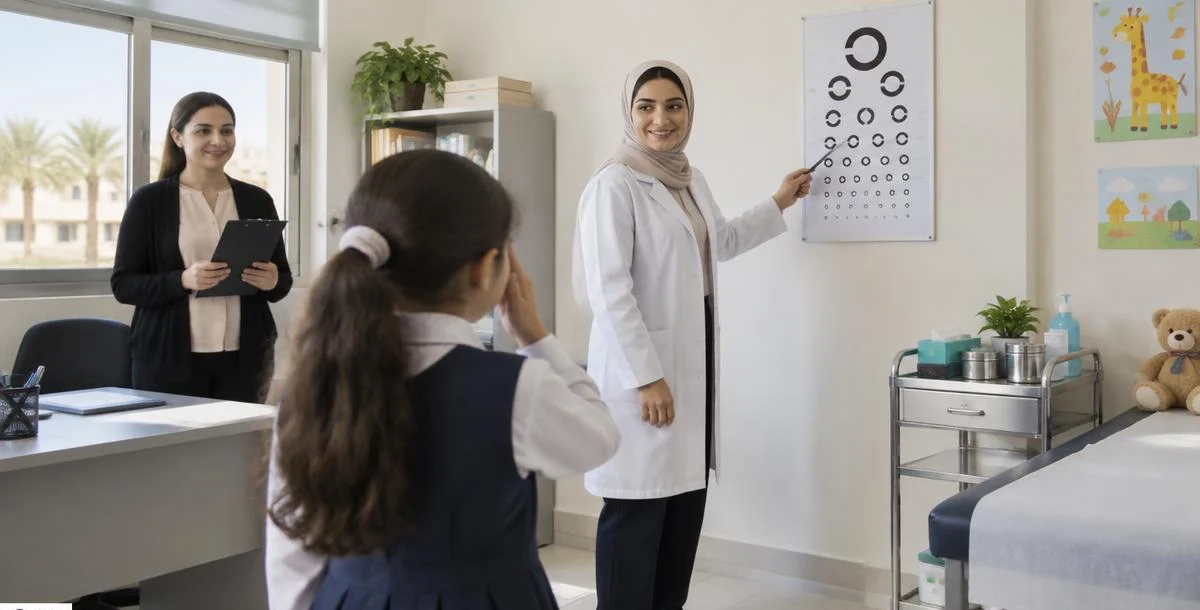
Vision screening can identify students who need further assessment, but it does not diagnose every eye condition. Use age-appropriate methods, a suitable environment and staff trained in the protocol. A child who struggles to see the board, repeatedly squints or reports visual difficulty should not be labelled inattentive without considering a health concern. A failed screening needs communication and follow-up rather than an automatic glasses prescription. [4]
An ophthalmology assessment is different from reading an eye chart. Specialist examination and portable instruments should be selected according to the child's needs and the confirmed service scope. Hospitalia's network ophthalmology capability can inform a programme discussion, but pediatric suitability and school deployment must be confirmed separately. Sudden loss of vision, serious eye injury or severe eye pain needs urgent assessment, not a place on next month's screening list.
Hearing screening, otology and ENT referral
Hearing difficulties can affect classroom communication, yet a screening result alone does not explain their cause. Otoscopy looks at the ear canal and eardrum; hearing tests assess responses to sound using methods appropriate to age and cooperation. These are not interchangeable assessments. Suitable background noise, equipment checks and trained personnel matter, especially when testing occurs in a school rather than a dedicated audiology room. [5]
Arrange repeat testing or referral according to the clinical protocol. Communicate concerns discreetly and consider practical classroom support while assessment is pending. Hospitalia's network otology capability may be relevant to the referral discussion, but do not assume that every ear service includes pediatric audiology. A school must confirm available professionals, examination methods, reporting and referral arrangements rather than advertise comprehensive hearing diagnosis based on a single portable device.
Advanced mobile diagnostics: choose the right test, not the longest list
Advanced medical capability combines clinical judgement, appropriate equipment and accountable reporting. Hospitalia's network capabilities include checkups, echo, ophthalmology, otology and mobile diagnostics; this is not a claim that all are routine school screening services. Confirm the intended age range, indications, operator competence, device suitability, maintenance and reporting before considering deployment. Portable technology does not make an ordinary classroom an adequately prepared diagnostic facility.
Echocardiography uses ultrasound to assess the heart's structure and function. It is not the same as ECG, and should not be promoted as a universal school checkup for healthy children. A suspected cardiac problem requires an appropriate clinical pathway; whether an indicated examination can be delivered on site depends on pediatric expertise and confirmed arrangements. Do not promise that a normal echo excludes every cardiac problem or guarantees safety in sport. [6]
Share age groups, campus location and coverage needs. Ask Hospitalia to confirm expertise, specialties, devices and approvals before planning a screening event.
Discuss a school programmeAsthma care at school: an individual action plan
Students with asthma may need an individual plan that explains regular treatment, recognised symptoms, access to prescribed reliever medication and emergency escalation. The plan should come from the treating professional and be shared with authorised staff who need to act. A school clinic should not independently change long-term treatment. Confirm storage or authorised self-carry arrangements and avoid a system that makes a student's medicine inaccessible during symptoms. [2]
Include exercise, transport and school trips in planning. Teachers need role-appropriate instructions, not unrestricted access to a medical file. Explain who stays with a symptomatic student, who obtains trained help and who contacts emergency services when indicated. The purpose is safe participation with sensible support, not automatic exclusion from physical activity. Review plans after relevant changes and rehearse the communication pathway before a real emergency occurs.
Diabetes, seizures and other long-term conditions
School diabetes care requires an individual plan covering prescribed monitoring and treatment, meals, activity and responses to low or high glucose. Device use, insulin support and emergency medicines must follow authorised instructions and the competence of the responsible staff. Do not publish a generic dosing algorithm as a school policy. Students should be supported without being publicly singled out or prevented from learning because of avoidable administrative delays. [2]
For epilepsy or another long-term condition, document the child's usual presentation, prescribed response and criteria for urgent help with the treating team. Rescue medication, where prescribed, requires appropriate authorisation and training. The school's role is to deliver agreed support and escalate concerns, not make new diagnoses. Include coverage when the usual clinician is absent and a clear handover for substitutes, while limiting disclosure to the information each person actually needs.
Allergies, anaphylaxis and medication safety
A student with a known severe allergy needs a personalised emergency plan and accessible prescribed treatment under applicable rules. Serious allergic reactions can progress rapidly; staff must know how to recognise a possible emergency and activate the agreed response. Do not wait for a parent to arrive before seeking urgent help. The school should coordinate clinical instructions with food-service, classroom and activity arrangements without promising an entirely allergen-free environment. [2,3]
Medication safety starts before a dose is given. Establish written authorisation, student identification, labelling, expiry checks, secure storage and documentation of administration. Clarify who may give each medicine and how errors or missed doses are escalated. Staff should not casually share painkillers or antibiotics, or accept an unlabelled medicine with only a verbal message. The article provides planning principles, not medication instructions or a substitute for individual prescribing.
First aid and pediatric emergency preparedness
School first aid services need written escalation plans, trained personnel and a link to local emergency care. A clinic is not an emergency department. Severe breathing difficulty, collapse, a serious injury or a concerning altered level of consciousness requires the school's emergency response, not a scheduled consultation. Emergency planning should specify who calls for help, who provides care within training and who meets responders at the gate. [3]
Review equipment according to the risk assessment, qualified advice and local rules, including the suitability of any resuscitation equipment for children. Staff training should match the equipment actually present. Rehearse access routes, location information and communication during drills. Do not advertise an ambulance, advanced life support or immediate physician attendance unless those services are explicitly contracted and available. Preparedness also requires an incident review that improves the system without blaming the child.
Infection prevention and vaccination coordination
School infection prevention combines hand hygiene, cleaning, sensible ventilation, safe waste handling and a clear response when a student is unwell. Staff should know how to obtain clinical advice and communicate with families without making a diagnosis from classroom observation. Attendance or return-to-school decisions need applicable public-health guidance and individual circumstances, rather than an arbitrary rule copied from another country. [1]
Vaccination coordination may involve checking relevant documentation, giving families reliable information or referring to authorised providers. An on-site vaccination campaign is a separate clinical service requiring confirmed authorisation, appropriate staff, consent, storage and emergency arrangements. Do not imply that Hospitalia automatically supplies every childhood vaccine or replaces national immunisation programmes. Any campaign should be agreed with the relevant authorities and providers before invitations are sent to families.
Mental wellbeing, safeguarding and inclusive care
School health services should make it easier for a student to disclose a concern and reach appropriate help. Emotional distress, bullying or changes in behaviour warrant a thoughtful response, not an assumption that the child is difficult. Define referral arrangements for qualified mental-health assessment where needed; a general clinic should not claim a specialist service that is not staffed or contracted. Serious immediate safety concerns require the agreed urgent response. [1,3]
Safeguarding is part of clinical quality. Set clear rules for consent, age-appropriate assent, examination privacy, chaperones and reporting concerns under applicable requirements. Explain the limits of confidentiality before collecting sensitive information. Adapt communication and access for students with disabilities or language needs. Do not promise absolute secrecy where protection duties apply, and do not force children to disclose sensitive details in front of classmates or an unnecessary audience.
Digital school health records and telemedicine
Digital health tools can support consent tracking, authorised care plans, visit documentation, referral reminders and parent communication. They should reduce missed handovers rather than create another unmonitored inbox. Agree access permissions, retention, secure communication and correction of inaccurate information before collecting student data. A school dashboard should show service activity without unnecessarily exposing named diagnoses to leadership, teaching staff or an entire administrative team.
Hospitalia's tailored-platform and health-app capabilities can be discussed as a possible coordination layer, not a claim that a school-specific product is already deployed. Telemedicine may help connect to a professional where suitable, but it cannot replace examination when needed or delay emergency care. Confirm clinician licensing, child-consent arrangements, the supported clinical scope and what happens when connectivity fails. Technology should support accountable care, not automatic diagnosis.
Family communication, referrals and continuity
A screening programme is incomplete if families receive a result but no explanation of the next step. Agree who reviews results, which findings require urgent contact and how routine referrals are delivered. Explain that a screening concern may need confirmation, and provide a practical route to an appropriate clinician. Avoid guarantees of treatment, insurance approval or appointment availability outside the service agreement. [1,2]
Document whether the family received the message and whether follow-up information was returned where appropriate and authorised. Use accessible language and offer reasonable support for communication needs. A missed appointment should prompt a supportive conversation, not a punitive label. School staff need relevant accommodations or action instructions; they do not automatically need a full specialist report. Continuity means a responsible person owns the handover rather than assuming someone else will act.
How to compare school medical service providers and cost
Compare a defined scope rather than a headline price per student. Request staffing hours, professional credentials, supervision, age suitability, equipment, consumables, reporting, referral coordination and emergency boundaries. Identify exclusions such as laboratory tests, external specialist visits, transport or medicines. A lower quotation can reflect less coverage rather than greater efficiency. This guide does not publish invented school clinic prices or claim a standard Hospitalia package.
Ask how the provider handles staff absence, incidents, safeguarding concerns and complaints. Agree service measures such as care-plan completion, authorised medication documentation and closed referral handovers. Attendance, satisfaction and cost can be evaluated, but reduced absenteeism or improved grades are not guaranteed outcomes. The highest-quality school medical capabilities are those that can be delivered safely and consistently to the actual student population, with transparent responsibilities and a realistic budget.
Discuss a school healthcare programme with Hospitalia
Hospitalia's confirmed network capabilities provide a starting point for an organisational discussion: on-site checkups, ophthalmology, otology, echocardiography and mobile diagnostic services, alongside digital-health coordination. School delivery needs a separate assessment of pediatric competence, local approvals, staffing, consent and equipment suitability. Share the school location, age groups, student numbers, timetable, existing clinic arrangements and clinical priorities so the team can confirm what is feasible and what requires external referral.
For Egypt, confirm coverage for the actual campus and dates directly with Hospitalia. For Saudi Arabia, this guide supports school-health planning and partnership inquiries, not a claim of local student bookings or licensed delivery. Saudi and Egyptian requirements are not interchangeable. Any Saudi-facing service must be confirmed with appropriately licensed local partners and applicable authorities before a school promotes it to families or incorporates it into its health policy.
School clinic launch checklist
- Assess age groups, care needs, known conditions, activity hours and campus layout.
- Confirm licences, pediatric competence, supervision, real coverage, absence cover and exclusions.
- Prepare safe, private, clean and accessible clinical space with equipment matched to the agreed scope.
- Document consent, chronic-condition plans, medication rules, safeguarding and record permissions.
- Agree referral, emergency and family-communication pathways; train staff for their assigned roles.
- Review completed follow-up, incidents, complaints and service measures, then improve the programme.
Talk to Hospitalia to confirm clinical scope, campus coverage, pediatric suitability and an itemised quotation. Saudi inquiries are for partnerships, not local student bookings.
Contact HospitaliaMedical references and editorial scope
This guide supports service planning; it does not diagnose a student or prescribe treatment. International sources inform care, screening and emergency principles, not Egyptian or Saudi legal requirements or an individual clinician's assessment. No independent clinical reviewer is claimed. The generated cover image is illustrative, not documentation of Hospitalia staff, a client school or actual equipment. Reading time is an estimate.
Frequently asked questions
What should school medical services include?
A defined programme may combine assessment and first aid, individual care plans, medication safety, clinically justified screening, family communication and referrals. Staffing, age suitability and emergency boundaries should be agreed for the school. Not every programme includes the same tests or specialists.
Does every school need both a nurse and a doctor?
Coverage depends on student needs, campus layout, medical complexity and applicable local requirements. A scheduled doctor visit does not replace all nursing functions. Confirm licences, pediatric experience, supervision, cover for absence and the hours during which support is actually available.
Are echo and ECG routine tests for every student?
No universal cardiac-testing package is recommended in this guide. Echo and ECG answer different clinical questions. A qualified clinician should determine whether assessment is indicated, with pediatric expertise and appropriate referral or testing arrangements. Neither provides an absolute guarantee of sports safety.
What is the difference between vision screening and an eye examination?
Screening identifies possible concerns that need further assessment. A comprehensive eye examination investigates eye health more fully. A failed school screening is not a diagnosis and should be followed by communication with the family and an appropriate clinical pathway.
How should a school support a child with asthma or diabetes?
Use an individual plan agreed with the treating team and family. Document authorised treatment, daily support, emergency actions, trained staff and communication. Include sports and trips. This guide does not provide doses or authorise a school to change prescribed treatment.
Can Hospitalia provide advanced school diagnostic services?
Hospitalia has confirmed network capabilities in checkups, echo, ophthalmology, otology and mobile diagnostics. School deployment, pediatric expertise, specific devices, approvals and availability need separate confirmation. General network capability is not proof that every service is suitable for every school or child.
How much does a school medical programme cost?
Cost depends on campus location, student numbers and ages, coverage hours, clinical complexity, staffing, equipment and follow-up. Request an itemised proposal with exclusions. No unverified school package prices are published here.
Does this guide mean Hospitalia offers student bookings in Saudi Arabia?
No. Saudi-facing content is educational and supports institutional partnership inquiries. Local delivery and licensing must be confirmed separately. Schools in Egypt should also confirm campus coverage and the precise clinical scope directly with the team.