Software vs. Service: Why Egypt's Corporate Healthcare Needs Both

Quick answer
"Software will replace healthcare services" and "technology is just hype" are both wrong. Here is the case for the hybrid model, and the checklist for evaluating a provider against it.
There is a debate running through corporate healthcare procurement in Egypt that deserves to be named and then dismissed. On one side: software will eventually replace healthcare services, so buy the platform. On the other: health technology is mostly hype, so buy people and ignore the dashboards. Both positions are held sincerely, and both produce bad procurement decisions.
The honest answer for an Egyptian employer is neither extreme, and it is not a diplomatic middle ground either. Software and service solve genuinely different problems. A benefits program that only has one of them fails in a predictable, specific way — and knowing which way is what makes this a useful distinction rather than a truism.
What software does well — data, scale, and consistency
The strengths of a digital layer are real and should not be undersold by anyone whose business is service delivery.
- Enrollment and eligibility workflows: onboarding hundreds of employees, tracking who is covered for what, and keeping that current as people join and leave — work that is error-prone and expensive when done by hand.
- Scheduling at scale: matching clinical capacity against demand across sites and shifts, with the rescheduling that real workplaces inevitably generate.
- Adherence and follow-up tracking: knowing who was contacted, who was missed, and who dropped out, reliably, rather than relying on a coordinator's memory.
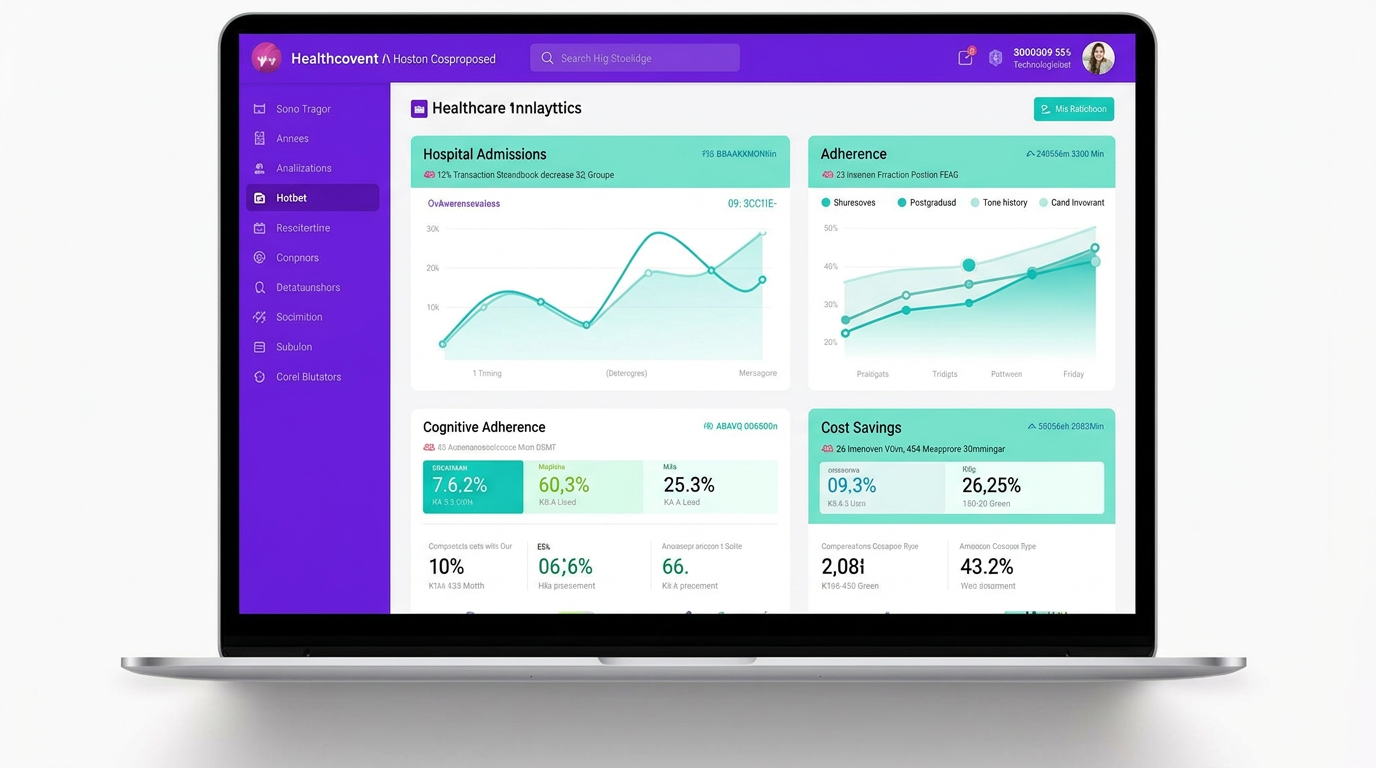
- Reporting dashboards: utilisation, case mix, response times, and outcome measures presented consistently enough that an HR lead can defend the budget line to a CFO.
- Consistency: a process encoded in software runs the same way on a busy week as on a quiet one, which is exactly where manual processes degrade.
This software layer is maturing quickly in the region. Platforms such as CareSync (care-sync.co), a white-label digital health SaaS company operating across Saudi Arabia and Egypt, focus specifically on this layer — giving hospitals and pharma partners the technology backbone for patient engagement and support programs.
What software cannot do — the physical reality of care
Then there is the part that has never been digitised anywhere, in any market, at any level of funding.
- A nurse still has to give the injection, check the site, and stay for the monitoring window.
- A physiotherapist still needs hands on a patient for a session to have any therapeutic value.
- A company doctor still has to physically examine the employee who reports chest tightness, dizziness, or a workplace injury.
- An occupational health screening on a factory floor requires equipment, a clinician, and presence at a shift change — not a notification.
- A patient who has stopped a therapy because of an unspoken fear usually only says so to a person sitting in front of them.
This is where Hospitalia operates. It is also, bluntly, the harder half to build: recruiting and credentialing licensed clinical staff, covering governorates beyond Cairo, and running schedules that survive contact with real shift patterns is slower and less scalable than shipping a feature. It is also the half that actually changes an employee's health.
See how our corporate programs pair on-site and home clinical delivery with scheduling, telemedicine access, and reporting.
Explore corporate healthcareThe hybrid model — what it looks like in practice
A hybrid provider is not a service company with a login page. It is one where the digital layer and the clinical layer are designed against each other, so that what happens in the app changes what happens in the visit and vice versa.
| Function | Digital layer | Clinical layer |
|---|---|---|
| Employee onboarding | Eligibility, enrollment, and communication at scale | Baseline screening and clinical intake where indicated |
| Day-to-day access | Telemedicine consults, triage, and appointment booking | On-site clinic hours and home visits where examination is required |
| Chronic and follow-up care | Reminders, follow-up scheduling, adherence tracking | Nursing visits, physiotherapy sessions, and physician review |
| Occupational health | Scheduling campaigns, records, and compliance tracking | Screening, vaccination, and fitness-to-work assessment on site |
| Accountability to HR | Utilisation and outcome reporting | Clinical governance behind every number in the report |
Read that table as a test rather than a description. If a prospective provider can only populate one of the two columns credibly, you are buying half a program and will spend the next year filling the other half yourself.
What employers should actually evaluate
A short, deliberately awkward checklist. These questions are easy for a genuine hybrid provider to answer and uncomfortable for anyone else.
- Ask to see the reporting output from a real (anonymised) client, not a demo dashboard populated with sample data.
- Ask how many licensed clinical staff they directly engage, and in which governorates — a subcontracted network is not disqualifying, but you should know it exists.
- Ask what happens in the first 48 hours after an employee reports a problem, step by step, naming who does what.
- Ask how the platform handles an employee outside their core coverage area, because that answer describes the real footprint.
- Ask what integrates with your HR system today versus what is on a roadmap — and get the distinction in writing.
- Ask for the escalation pathway for a clinical emergency during an on-site clinic day.
Our corporate healthcare programs cover on-site clinics, home healthcare, occupational health, telemedicine access, and monthly reporting.
Book a consultationFrequently asked questions
Is Hospitalia a software platform or a service provider?
Hospitalia is a healthcare service provider — our core is licensed clinical delivery: on-site clinics, home nursing, physiotherapy, occupational health, and patient support programs. We use technology to coordinate that delivery and to report on it: scheduling, telemedicine access, structured visit documentation, and monthly reporting for corporate clients. We do not sell software as a product, and we would treat any provider describing themselves as both a platform vendor and a full clinical delivery organisation with some scepticism unless they can evidence both.
Can our company get both a digital dashboard and on-site care from one partner?
Yes, and consolidating them is usually the better arrangement because the reporting then reflects the care that was actually delivered rather than data re-entered from a separate provider. In our corporate programs, scheduling, telemedicine access, and reporting sit alongside the on-site and home clinical services in one relationship. The practical benefit for HR is a single accountable party: when utilisation looks wrong, there is no gap between the software vendor and the clinical team to argue across.
How does Hospitalia's technology integrate with our existing HR systems?
Integration depth depends on your systems and what your HR and IT teams are comfortable exposing. In practice, most corporate clients start with structured eligibility and enrollment exchange plus scheduled reporting delivered in an agreed format, which covers the majority of the administrative burden without a lengthy IT project. Deeper integration is scoped case by case. Our recommendation is to begin with the data flows that remove duplicate entry, prove the program works, and expand from there rather than making a full integration a precondition for launch.