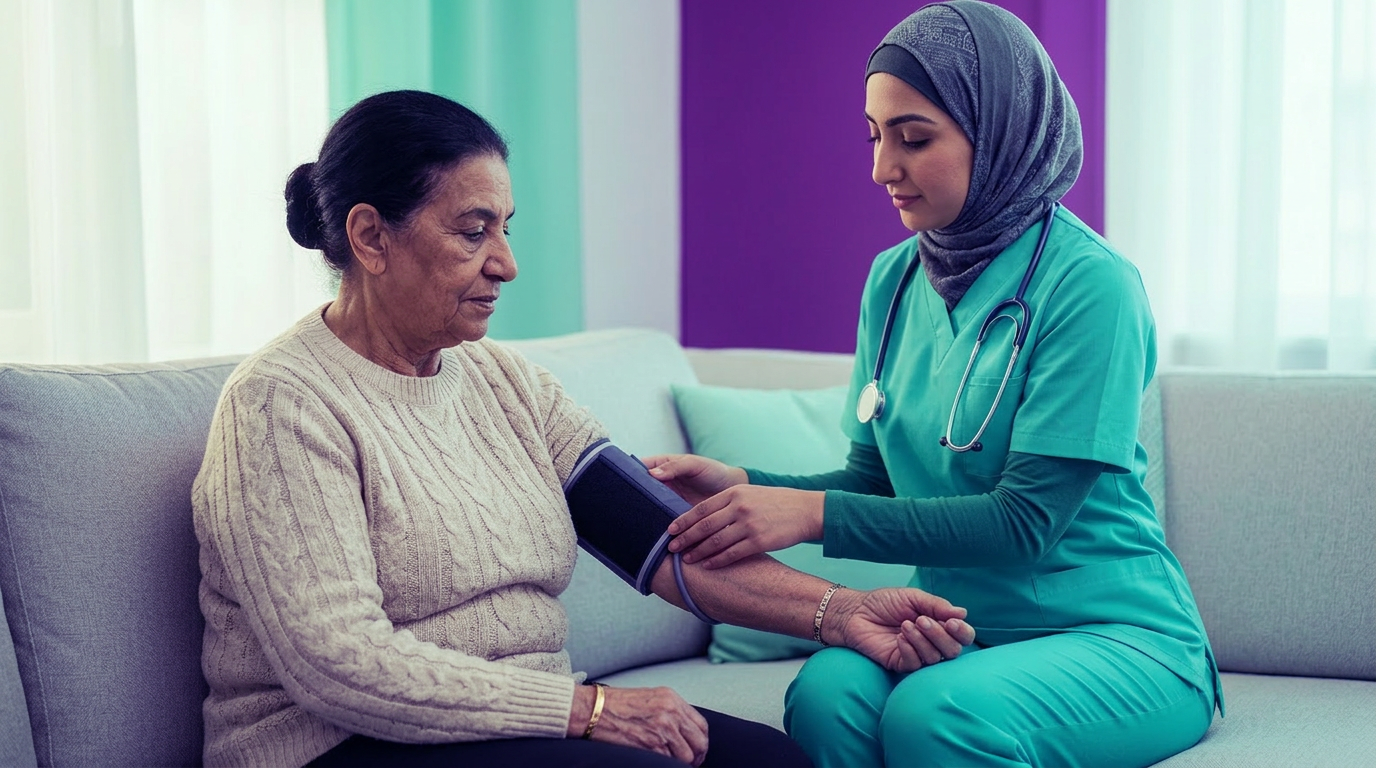
Elderly Home Care vs. Nursing Homes in Egypt: Cost and Quality Compared

Quick answer
A practical comparison of elderly home care and nursing homes in Egypt — monthly cost, medical supervision, emergency response, psychological impact, and dementia-specific care.
Deciding how to care for a parent is one of the hardest choices a family makes, and it is rarely a purely medical one. In Egypt it carries strong social and cultural weight around what it means for an elder to stay in their own home. This guide does not prescribe an answer — it lays out the practical differences so the decision can be made with clear eyes.
Side-by-side comparison
| Criterion | Care at home | Nursing home |
|---|---|---|
| Monthly cost | 000–000 EGP depending on hours | 000–000 EGP depending on facility tier |
| Medical supervision | Scheduled visits and monitoring per care plan | Resident or on-site staff |
| Family access | Continuous and unrestricted | Limited by visiting hours and policy |
| Psychological impact | Familiar surroundings preserve routine and spatial memory | Environmental change can cause initial disorientation |
| Emergency response | Depends on an escalation plan and hospital proximity | Faster response within the facility |
| Social interaction | Depends on family and visitors | Daily contact with other residents |
The real difference is not cost alone. Home care offers control and environmental continuity; a facility offers supervision density and structured social contact. The right answer depends on clinical stability, dependency level, and how much the family can realistically oversee.
A short home assessment establishes the actual dependency level and the hours of care genuinely required — the hardest thing to judge from the outside.
Book NowA decision checklist you can use
Answer these honestly. The more 'yes' answers, the more sensible home care usually becomes:
- Is the medical condition stable, without frequent urgent intervention?
- Can the home be adapted safely — bathroom, stairs, night lighting, grab rails?
- Is there a family member able to coordinate and oversee, even with a care team in place?
- Does the elder prefer to stay at home, and does that preference visibly affect their mood?
- Does the monthly budget cover the hours actually needed, not just the minimum?
- Is there a clear emergency plan and a suitable hospital nearby?
Alzheimer's and dementia: a different kind of care
Dementia changes the equation. In early and moderate stages, patients often do better in a familiar setting, because spatial memory and daily routine reduce confusion and late-day agitation. But this care requires different preparation from general elderly support:
- Routine stability: sleep, meals and activities at the same times in the same order each day.
- Wandering safety: secure locks, night lighting, and clear hallways.
- Managing agitation through de-escalation rather than confrontation, avoiding repeated correction.
- Staff trained specifically in dementia communication, not general care alone.
- Support for the primary family caregiver, where emotional strain accumulates quickly.
In advanced stages, when swallowing or mobility deteriorate or complications recur, families usually need to revisit the decision. That is a normal part of the trajectory, not a reversal of an earlier choice.
The middle option many families overlook
The choice is not necessarily binary. Many families begin with a hybrid model: limited daily home care hours, periodic physician visits, and weekly physiotherapy, then increase hours gradually as needs change. It spreads the cost over time and gives the family room to see what actually works.
From short daily visits to full residential cover, with clinical supervision and regular family reporting across Egypt.
Book NowFrequently asked questions
Which is genuinely cheaper — home or a facility?
It depends on hours. Limited daily home care is usually less expensive than a nursing home, whereas 24-hour live-in cover can approach or exceed the cost of a good facility.
Is home care safe for Alzheimer's patients?
In early and moderate stages it is often appropriate, provided the home is made safe and the team is trained in dementia care. Advanced stages warrant a fresh clinical review.
How many care hours a day does an older adult need?
It ranges from around 4 hours daily for bathing, meals and medication support, to full round-the-clock cover in high-dependency cases. A home assessment is the only reliable way to estimate it.
Can home care be combined with physiotherapy?
Yes, and it is very common. A weekly strength and balance programme alongside daily care typically helps maintain mobility and reduce fall risk.
What if the plan needs to change later?
Care needs normally change over time. Good arrangements include periodic plan reviews and the ability to increase or reduce hours without starting over.