Occupational Health Services for Factories in Egypt: Complete Employer Guide
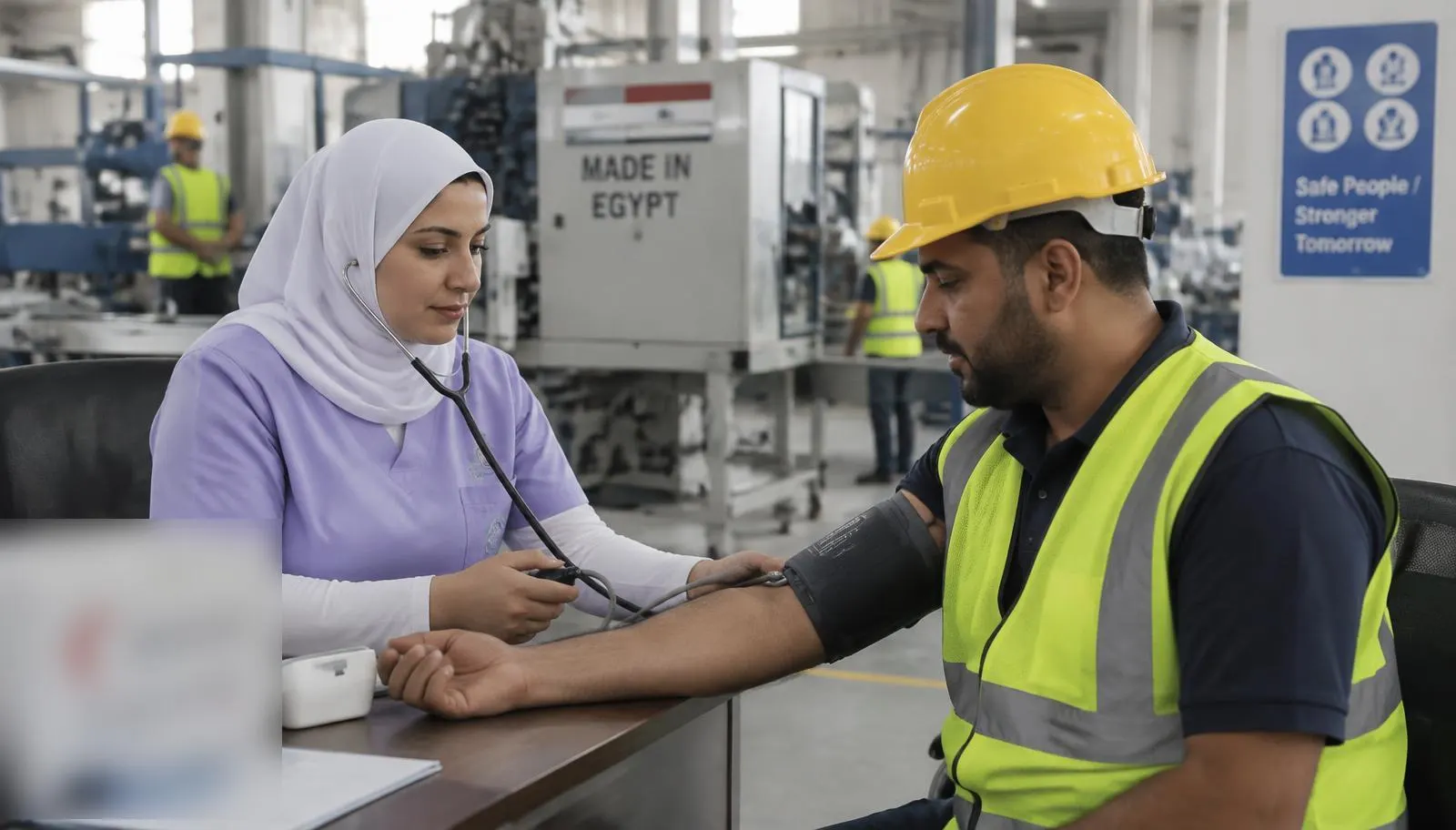
Quick answer
Factory occupational health combines exposure assessment, role-matched health surveillance, fitness advice and confidential records. A qualified clinician and local advisers should determine tests, intervals and applicable obligations.
Factory owners and operations leaders in Egypt tend to encounter occupational health services in one of two ways: proactively, as part of building a compliant and safe operation from the ground up, or reactively, after an incident, an audit, or an insurance requirement forces the issue. Both paths lead to the same question — what does a factory in Egypt actually need to have in place, and what does getting it right look like in practice?
This guide covers occupational health services for factories in Egypt end to end: what the function actually includes, the screenings and assessments most industrial employers need, how it differs from (and connects to) an on-site clinic, and how to evaluate a provider.
What "Occupational Health Services" Actually Covers
Occupational health is often confused with having an on-site clinic, but the two are not the same thing. Occupational health is the compliance and prevention layer — it exists to confirm workers are fit for the specific job they're doing, catch exposure-related health issues before they become disabling, and maintain the documentation a factory needs for audits, insurance, and labor inspections. The International Labour Organization defines occupational health services as entrusted with "essentially preventive functions," responsible for advising employers and workers on maintaining a working environment that promotes health and safety.
An on-site clinic, by contrast, is the day-to-day treatment point (see our guide on setting up an on-site clinic in Egypt). A factory can have strong occupational health services without a full clinic, and vice versa — though in practice, the two are usually delivered together by the same corporate healthcare provider for operational simplicity.
Why This Matters Beyond Compliance
For Egyptian factory operators, occupational health services for factories deliver value on three fronts:
- Obtain Egyptian legal advice on role-specific assessment and employment decisions, including confidentiality, reasonable adjustments and review of adverse findings. Do not automatically reject an applicant on a test result.
- Keep appropriate compliance documentation and obtain local legal advice; documentation does not guarantee protection from liability or an insurance outcome.
- Operational continuity — catching early signs of exposure-related conditions (respiratory issues from dust or fume exposure, hearing loss from prolonged noise exposure, musculoskeletal strain) before they force a worker off the line entirely.
This is the business case most factory owners underweight: occupational health is often framed purely as a cost center, when in a facility with meaningful hazard exposure, it functions as an early-warning system that protects both the worker and the production schedule. The WHO and ILO formally recognize this dual role through their Joint Committee on Occupational Health, which has worked since 1950 to extend basic occupational health coverage and reduce the global burden of work-related injury and disease.
Core Components of an Occupational Health Program
A complete program for a factory in Egypt typically includes:
Pre-employment medical examinations — confirming a candidate is medically fit for the specific physical demands and hazard exposures of the role before they start. See our dedicated guide: pre-employment medical examination in Egypt.
Periodic health screening — ongoing monitoring at a frequency matched to job risk (detailed in Section 6), covering general health markers plus exposure-specific tests.
Workplace hazard and ergonomic assessments — evaluating noise levels, air quality, chemical exposure, manual handling risk, and workstation design to identify where intervention is needed before it shows up as a health complaint.
Fitness-to-work and return-to-work evaluations — assessing whether an employee can safely perform their role after illness, injury, or extended leave, and whether modified duties are needed.
Injury and incident medical response protocols — a defined process for immediate medical response to workplace injuries, including when to treat on-site versus refer to hospital.
Health record-keeping and reporting — maintaining confidential, audit-ready documentation that satisfies both regulatory requirements and internal HR/safety reporting needs. ILO Convention No. 161 specifically requires that occupational health personnel be informed of occurrences of ill health among workers and of absences for health reasons, within the limits of professional confidentiality.
Vaccination coverage, where relevant to the role or facility — see our corporate vaccination program guide for how this is typically structured.
Risk-Based Screening: Matching Tests to Job Exposure
Not every factory role needs the same screening panel, and a one-size-fits-all program either over-tests low-risk roles (wasting budget) or under-tests high-risk ones (creating real exposure liability). A risk-based approach typically groups roles into tiers:
- Assess each actual exposure, its intensity and controls; a clinician selects relevant surveillance and intervals under applicable requirements. Job titles alone do not establish a testing panel.
Combine clinician-led follow-up, appropriate monitoring, adherence support and escalation. Frequency and care setting are individual decisions; no component is universally the cheapest or highest-return.
Occupational Health vs. On-Site Clinic: How They Connect
Employers frequently ask whether they need an on-site clinic, an occupational health program, or both. In practice:
- A standalone occupational health program (without a full clinic) covers pre-employment exams, periodic screening, and hazard assessments, usually delivered via scheduled visits rather than daily presence — workable for lower-risk facilities or smaller operations.
- A standalone on-site clinic (without a formal occupational health program) handles day-to-day acute care but leaves compliance and preventive screening unaddressed — a gap that shows up during audits or injury claims.
- Workplace arrangements may make care and follow-up easier to access. Results depend on scope, participation and clinical needs; measure against a baseline rather than assuming savings or guaranteed outcomes.
For a full cost comparison of these structures, see our guide on on-site clinic cost in Egypt.
How Often Should Factory Workers Be Screened?
| Exposure assessment | Surveillance decision |
|---|---|
| Noise | Assess measured exposure and applicable audiometry requirements |
| Dust, fumes or chemicals | Select substance-specific surveillance; do not infer tests from job title |
| Physical demands or shift work | Consider clinical needs, ergonomics and appropriate intervals |
For a full breakdown of what a general annual screening should include regardless of risk tier, see annual employee medical screening in Egypt.
Choosing an Occupational Health Provider in Egypt
When evaluating providers for occupational health services for factories in Egypt, ask specifically:
- Do they design risk-tiered screening programs, or offer a single fixed panel regardless of job exposure?
- Can they conduct hazard and ergonomic assessments on-site, or only off-site consultations?
- Confirm authorized clinical access and restrict employer reporting to necessary fitness information and de-identified aggregates, with small-group disclosure safeguards.
- Do they offer combined on-site clinic + occupational health delivery, or only one of the two?
- What's their response protocol for workplace injuries, and how quickly can they mobilize for multi-site operations?
Our broader guide on how to choose a corporate healthcare provider in Egypt covers the full vendor evaluation framework, including questions specific to pricing transparency and contract structure.
Implementation Checklist for Factory Owners
- Map all roles into risk tiers based on hazard exposure
- Confirm pre-employment exam protocol matches each role's risk tier
- Set periodic screening frequency and hazard-specific tests per tier
- Commission a workplace hazard and ergonomic assessment
- Define a documented injury/incident medical response protocol
- Establish a confidential, audit-ready health record-keeping system
- Decide whether occupational health will be delivered standalone or combined with an on-site clinic
- Confirm vaccination needs relevant to the facility or role exposure
Share your site, headcount, shifts and required scope for a tailored proposal. Do not send personal medical records in a business enquiry.
Request a corporate proposalFrequently asked questions
Is occupational health legally required for factories in Egypt?
Factory occupational health combines exposure assessment, role-matched health surveillance, fitness advice and confidential records. A qualified clinician and local advisers should determine tests, intervals and applicable obligations.
What's the difference between occupational health and an on-site clinic?
Occupational health is the preventive and compliance layer — screening, hazard assessment, fitness-to-work documentation. An on-site clinic is the day-to-day treatment point. Most factories benefit from combining both under one provider.
How often do high-risk factory workers need to be screened?
Factory occupational health combines exposure assessment, role-matched health surveillance, fitness advice and confidential records. A qualified clinician and local advisers should determine tests, intervals and applicable obligations.
Does occupational health cover pre-employment exams?
Yes — pre-employment medical examination is a core, usually first, component of an occupational health program. See our dedicated guide: pre-employment medical examination in Egypt.
Can a small factory with under 100 workers justify a full occupational health program?
Choose services from actual exposures and applicable duties, not headcount alone. A smaller workforce does not justify reducing surveillance required for the same exposure.