Fall Prevention for Elderly at Home in Egypt: A Room-by-Room Checklist and What to Do After a Fall

Quick answer
A practical guide for Egyptian families: why older people fall, a room-by-room home checklist, what to do if a fall happens, and when a home nurse or physiotherapist can help.
Short answer: to prevent falls in an older person at home, remove trip hazards, light every night-time route, secure the bathroom, keep them strong and balanced with regular exercise, and review their medicines, eyesight and footwear with their doctor. WHO says home hazard assessment and balance-challenging exercise reduce falls in older people. This guide is educational.
- WHO estimates about 842,000 deaths from falls worldwide in 2023, making falls the second-leading cause of unintentional injury death after road injuries; about 71% of those deaths were in adults aged 60 and over.
- WHO reports that balance-challenging exercise reduced fall rates by about 23% in a Cochrane review, and that home hazard assessment and modification reduced falls by about 38% in people already at higher risk.
- The NHS recommends strength and balance activities at least twice a week, regular eye and hearing checks, a medicines review if balance is affected, and well-fitting shoes or slippers with a good grip.
- Egypt's elderly population is growing: CAPMAS figures reported on 1 October 2026 put people aged 60+ at about 10.2 million, or 9.3% of the population, so home safety is now an everyday family issue, not a niche one.
- If someone falls and may have hurt their head, back, neck or hip, or cannot get up, do not lift them: call 123 for an ambulance and keep them warm and comfortable.
Why older people fall at home — and why it matters
The NHS lists common causes of falls in older people: weakening muscles, conditions that affect mobility or balance such as arthritis, stroke or Parkinson's disease, low blood pressure, side effects of some medicines, eyesight or hearing problems, and dementia. WHO adds that unsafe stairs, poor lighting, unsafe walking surfaces and substandard housing raise the risk. Most of these are not about "being careless": they are the ordinary changes of ageing meeting an ordinary home.
The scale is large. WHO's falls fact sheet estimates about 842,000 deaths from falls worldwide in 2023, with about 71% among people aged 60 and older. In Egypt, CAPMAS figures reported on 1 October 2026 show about 10.2 million people aged 60+ (9.3% of the population), up from 9.8 million in 2025. We could not find a reliable, published Egypt-specific figure for how many older Egyptians fall at home each year, so this guide does not quote one. What the evidence does show is that prevention works, which is where families have the most control.
A room-by-room home safety checklist
The checklist below combines NHS home-hazard advice and WHO's recommendation for home hazard assessment. Walk through the flat with the older person, ideally in the evening, and fix what you can before the next fall rather than after.
| Area | What to check or change |
|---|---|
| Floors and walkways | Clear clutter; remove loose wires and small rugs, or fix them down; keep the route from bed to bathroom open. |
| Bathroom | Use a non-slip mat in the bath or shower; consider grab rails and a seat if balance is poor; keep the floor dry. The bathroom is where many families should start. |
| Stairs and steps | Consider safety rails on steps; keep every stair well lit; do not store things on stairs. If stairs are a problem, ask a physiotherapist to practise them with the person. |
| Lighting | Light the whole route from bedroom to toilet at night; keep a torch or night light within reach. |
| Bedroom | Bed at a height from which the person can sit and stand easily; phone or personal alarm within reach; do not leave walking aids out of reach. |
| Footwear | Shoes or slippers that fit well, stay on the foot and have a good grip; avoid socks alone or loose backless slippers on tiles. |
| Living room | Chairs with a firm seat and arms make standing up easier; avoid low sofas the person struggles to get out of. |
Tiled and marble floors are common in Egyptian flats and become slippery when wet, so the bathroom and kitchen deserve extra attention. This is a practical observation, not a statistic.
Strength, balance, eyes, medicines: the risks you cannot see on a floor plan
Exercise. WHO reports that balance-challenging exercise reduced fall rates by about 23% in a Cochrane review. The NHS advises activities that improve strength and balance at least twice a week and being active every day. Which exercises are safe depends on the person's heart, joints and past falls, so ask the doctor or a physiotherapist for a programme rather than copying one from the internet.
Medicines. The NHS advises speaking to a doctor or pharmacist if you think medicines may be affecting balance. In practice, bring all the person's medicines, including supplements, to one review and ask: could any of these cause dizziness or low blood pressure on standing? Never stop a prescribed medicine on your own.
Eyes and ears. The NHS advises regular eye tests and hearing checks, because ear problems can affect balance. A new pair of glasses, or treated cataracts, can change how safe the same hallway is.
Food, fluids and bones. The NHS notes that not eating and drinking enough can cause lightheadedness or fainting, and advises calcium-rich foods and enough vitamin D for bone health. Ask the doctor before starting supplements.
Help with hard tasks. The NHS advises avoiding tasks that are hard, such as lifting or reaching, and asking for help. Move frequently used items to waist height so nobody has to climb on a chair.
What to do if an older person falls
The NHS gives clear steps. Teach them to the whole family and the carer before an incident happens.
- If the person is conscious and calm, check for pain or injury before moving them, and do not let them get up too quickly.
- If they may have injured their head, back, neck or hip, or cannot get up, do not try to lift them. Call 123 for an ambulance in Egypt, keep them warm with a blanket or coat, and stay with them. (The NHS gives UK numbers; 123 is Egypt's ambulance number.)
- If they can get up, the NHS describes rolling onto the side, pushing up onto hands and knees, reaching a sturdy piece of furniture, placing one foot flat and standing slowly, then sitting down to rest. Help carefully; do not lift them yourself.
- If they are alone and cannot get up, the NHS advises using a phone or personal alarm, calling out or banging on the wall or floor, covering up to keep warm, and changing position about every 30 minutes to help prevent pressure sores.
- After any fall, even without obvious injury, tell the doctor. The NHS says to see a GP if you are worried about balance or mobility or have had a fall, and a falls assessment can check muscle weakness, bones, eyesight and medicines.
A realistic scenario: a grandmother in Dokki
Consider an illustrative example, not a Hospitalia client case. A 78-year-old woman in Dokki lives in a third-floor flat with her son's family. She wakes twice a night to use the bathroom, wears backless slippers on marble tiles and takes several daily medicines. One night she slips on the wet bathroom floor and cannot get up. Afterwards the family does five things: they ask her doctor to review her medicines and check her blood pressure on standing; they fit a non-slip mat, a grab rail and a night light on the route; they replace the slippers with a closed, gripped pair; they ask a physiotherapist to assess her walking and set a balance programme; and they teach everyone the "do not lift, call 123 if injured" rule. None of these steps is expensive or exotic, and together they address several of the causes the NHS and WHO list.
When a home nurse or physiotherapist helps
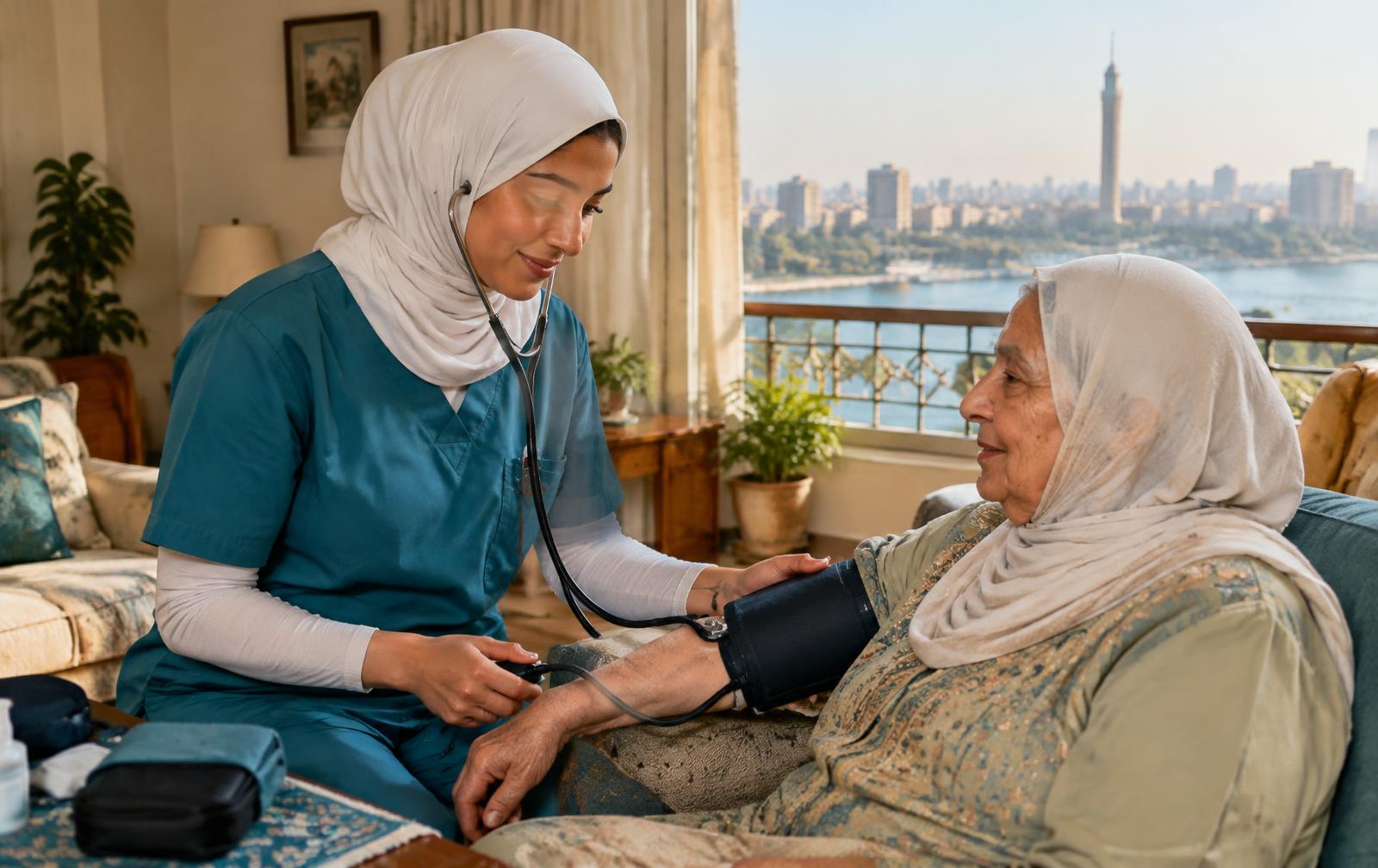
A home safety walkthrough, a balance and walking assessment, caregiver training in safe transfers, and medicine-list organisation are all things a visiting nurse or physiotherapist can support, within the doctor's plan. They do not diagnose the cause of a fall, change medicines or replace emergency care. Hospitalia is an Egypt-based integrated home healthcare platform offering home nursing, physiotherapy at home, doctor home visits, diagnostics and telemedicine. Assessment and booking confirm suitability, areas covered, visit frequency and commercial terms; home nursing is not continuous monitoring or an emergency service by default. See also our guides on how to choose a home nursing service in Egypt and home physiotherapy after knee replacement in Cairo, and the guides on stroke and dementia care at home for families managing higher fall risk.
Call 01063151838 or request a home nursing assessment, and we will confirm what can be arranged around the doctor's plan.
Request a home care assessmentFrequently asked questions
How can I prevent my elderly parent from falling at home?
Remove trip hazards, light night-time routes, secure the bathroom with a non-slip mat and grab rails, make sure shoes fit and grip, keep them active with strength and balance exercise, and review medicines, eyesight and hearing with their doctor. WHO says home hazard assessment and balance-challenging exercise reduce falls.
What should I do if an elderly person falls and cannot get up?
Do not try to lift them. If they may have hurt their head, back, neck or hip, call 123 for an ambulance, keep them warm and comfortable and stay with them. If they are unhurt and want to get up, help them to roll, kneel, reach a sturdy support and stand slowly, as the NHS describes.
Which room in the house is most dangerous for older people?
There is no single proven answer, but wet bathroom floors and stairs are classic hazards named in NHS and WHO advice. Start with the route from bed to bathroom at night, then the bathroom itself.
Do medicines cause falls in the elderly?
Some can: the NHS lists side effects of some medicines and low blood pressure among common causes of falls. Ask the doctor or pharmacist for a medicines review, and never stop a prescribed medicine on your own.
How often should an older person do balance exercises?
The NHS advises activities that improve strength and balance at least twice a week, and being active daily. A doctor or physiotherapist should confirm which exercises are safe for the person.
Can a nurse or physiotherapist visit my elderly parent at home in Cairo?
Home nursing and physiotherapy are available through providers such as Hospitalia. Suitability, areas covered, visit frequency and commercial terms are confirmed at assessment and booking.