Home Physiotherapy After Knee Replacement in Cairo: Recovery Timeline, Exercises and Warning Signs

Quick answer
A practical guide for Egyptian families: what recovery looks like week by week, what home rehabilitation can and cannot do, and which symptoms need your surgeon urgently.
Short answer: home physiotherapy after knee replacement means a physiotherapist visits you at home to guide the exercise programme your surgeon's team has set, check your walking, swelling and knee movement, and teach the family how to help safely. It supports your surgeon's plan; it does not replace follow-up with the surgeon. This guide is educational.
- The NHS says it may take several months or longer to recover fully from a knee replacement, and that most people leave hospital 1 to 4 days after the operation if there are no complications and they can move safely on crutches or a frame.
- The NHS advises starting the exercises early because they help long-term knee strength and movement and help prevent complications, and keeping the leg raised as much as possible to reduce swelling.
- A 2015 systematic review in BMC Musculoskeletal Disorders (18 randomised trials, 1,739 patients) found no difference in physical function or pain between home-based and outpatient physiotherapy, and a short-term flexion benefit for home-based exercise at 3 to 4 months. The authors concluded that evidence was insufficient to say which delivery method is better.
- There is no single correct number of physiotherapy sessions. The surgeon's protocol and the knee's progress decide it, so ask your surgical team for their written rehabilitation plan before you are discharged.
- Leg pain with swelling plus breathlessness or chest pain is an emergency; a hot, red, oozing or increasingly painful knee, fever, or throbbing calf pain needs your surgeon's team urgently.
What ‘home physiotherapy after knee replacement’ actually covers
After a total knee replacement, the aim of rehabilitation is to regain bending and straightening of the knee, strength in the thigh and hip muscles, safe walking and independence in daily tasks. Hospital physiotherapists usually start mobilisation soon after surgery. Once you are home, the programme continues either at an outpatient clinic or with a physiotherapist visiting you. For many Cairo families the second option solves a real problem: a fresh knee, swelling, pain medicine and a taxi or microbus ride to a clinic across traffic do not mix well, and a family member often has to take unpaid leave to accompany the patient.
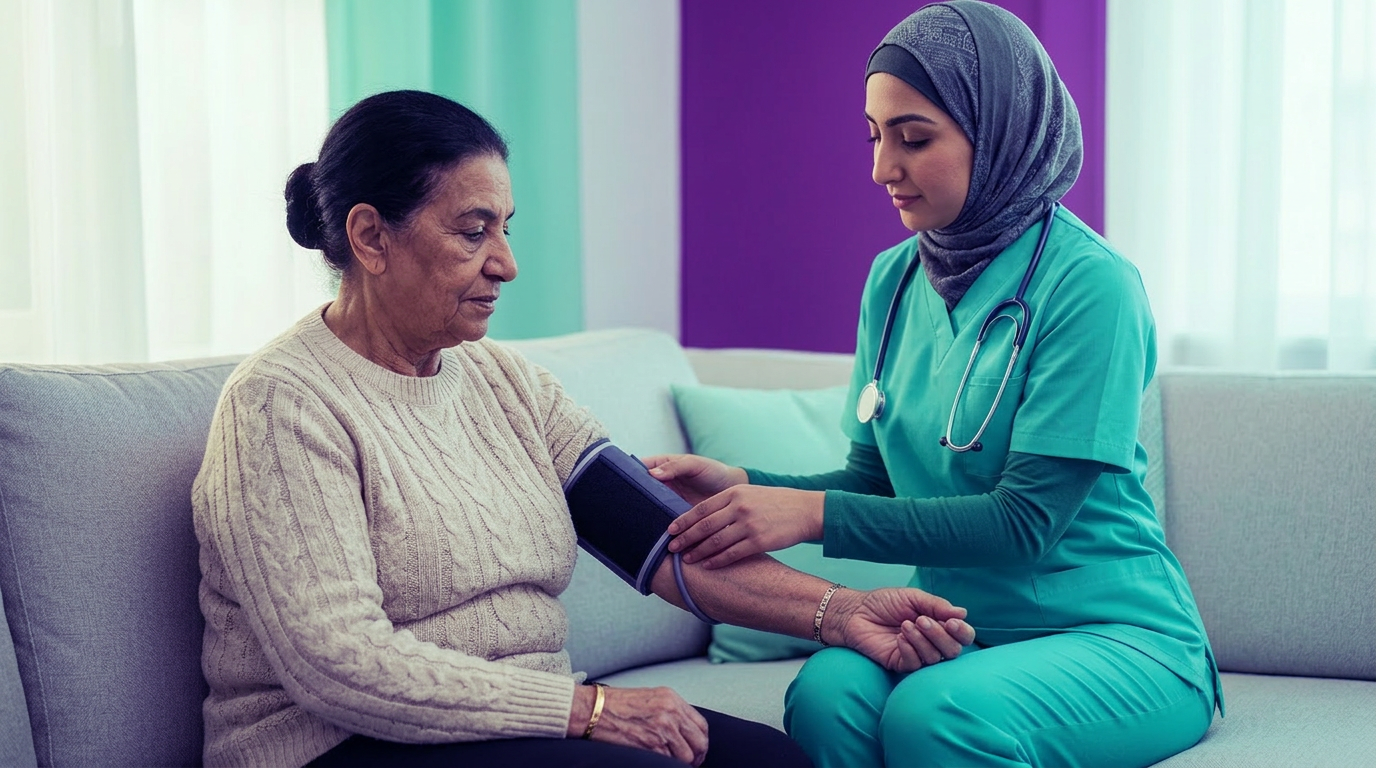
A visiting physiotherapist normally does four things: assesses the knee, walking, home layout and pain; carries out the exercise programme from the surgeon's protocol; adjusts the intensity as the knee responds; and trains the person and the carer in the home exercises. They do not change the surgeon's restrictions, interpret imaging, prescribe medicine, or decide that a wound problem is ‘nothing’.
Recovery timeline: what the NHS says to expect
The milestones below come from the NHS recovery page for knee replacement (last reviewed 9 September 2026). They are typical UK guidance, not a promise: your surgeon's instructions always take priority, and a partial replacement recovers faster than a total one.
| Stage | What the NHS says |
|---|---|
| Hospital stay | Usually 1 to 4 days if there are no complications and you can get around safely on crutches or a walking frame. |
| About 10 days | Stitches or clips are usually removed by a nurse after about 10 days. |
| First weeks | Start the exercises early, keep the leg raised to reduce swelling, and move from two crutches to one, then to a walking stick. |
| About 6 weeks | Compression stockings are usually worn for at least 6 weeks. Many people try walking without an aid at about 6 weeks if they feel ready. Follow-up appointment with the surgical team around this time. Do not sit with legs crossed for the first 6 weeks. |
| Driving | At least 6 weeks after a total knee replacement (3 weeks after a partial one), once your doctor confirms you are fit to drive. |
| Return to work | Usually about 6 to 12 weeks, depending on the job. |
| Around 3 months | Avoid heavy household tasks such as vacuuming or carrying shopping for the first 3 months. |
| Months and beyond | It may take several months or longer to recover fully. |
Home or clinic? What the evidence says
Artz and colleagues pooled 18 randomised trials with 1,739 patients after total knee replacement (BMC Musculoskeletal Disorders, 2015). Six of the trials compared home-based with outpatient provision. For physical function (up to 436 patients across five studies) and pain (248 patients at 3 to 4 months) there was no difference between the two. Knee flexion was better with home-based exercise at 3 to 4 months, but two studies found no longer-term advantage. The review did not report satisfaction, adverse events or cost, and the authors concluded that there were too few adequately sized studies to say which approach is better.
What this means in practice: home rehabilitation is a reasonable option when the programme is structured, the exercises are done regularly and a professional checks progress. The choice then comes down to safety, convenience and how well the person keeps to the programme. If the knee is stiff, the wound is slow to heal, or the person has other conditions such as diabetes, your surgeon may prefer closer supervision, and that decision is theirs.
A safe home set-up before the knee comes back from hospital
- Remove loose rugs and cables from the walking route, and keep a clear path from bed to bathroom with night lighting.
- Arrange a chair with arms and a firm seat, and a raised toilet seat or support rail if the surgeon's team advises it.
- Plan the stairs: if the bedroom or bathroom is on another floor, ask the physiotherapist to practise stairs with you before the first time you try alone.
- Keep the leg raised when resting, avoid a pillow under the knee, and do not kneel on the new knee until your surgeon says it is safe (NHS advice).
- Keep the medicine list and the surgeon's contact number visible on the fridge.
Exercise principles at home (not a replacement for your protocol)
Exercises differ between surgeons and implants, so this article does not give a routine to copy. The NHS notes that a physiotherapist or occupational therapist will agree a home exercise programme with you. What stays constant is the logic: short, regular sessions rather than one heavy session; gentle bending and straightening of the knee within the limits you are given; strengthening of thigh and hip muscles; walking practice with the correct aid; and rest with the leg raised between sessions. Pain that rises sharply after exercise, or swelling that does not settle with rest and elevation, should be reported to the physiotherapist and surgeon rather than pushed through.
Warning signs: when not to wait
The NHS lists these signs after knee replacement. Egypt's emergency numbers differ from the UK's, so contact your surgeon's team or go to a hospital emergency department, and call 123 for an ambulance if you cannot travel safely.
- Throbbing or cramping pain in the leg (possible blood clot): contact the surgical team urgently.
- High temperature, or feeling hot, cold or shivery; oozing or pus from the wound; redness, tenderness, swelling or pain in the knee that is not improving or is getting worse (possible infection): contact the surgical team urgently.
- Leg pain and swelling together with difficulty breathing or chest pain (possible blood clot in the lungs): emergency, go to the emergency department or call 123. Do not drive yourself.
A realistic scenario: a father in Heliopolis
Consider an illustrative example, not a Hospitalia client case. A 66-year-old man in Heliopolis goes home on day three after a total knee replacement. His daughter works full time and his son lives in Alexandria. The surgeon's team gave him a written exercise sheet and a follow-up date at six weeks. Instead of paying for taxis to a clinic three times a week, the family asks a physiotherapist to visit: the first visit checks the stairs to his flat, the walking frame, the swelling and the exercise technique, and trains his daughter to supervise the evening session. When he mentions a warm, tender calf, the physiotherapist tells the family to contact the surgeon's team the same day rather than wait for the next visit. The plan is still the surgeon's plan; the visits make it easier to follow.
How Hospitalia can help
Hospitalia is an Egypt-based integrated home healthcare platform offering physiotherapy at home, home nursing, doctor home visits, diagnostics and telemedicine. If your surgeon has set a rehabilitation protocol, you can request a physiotherapy assessment by phone or through the app or website, and we will confirm suitability, areas covered, visit frequency and commercial terms at booking. See also our guides on physiotherapy at home in Cairo and home care after surgery in Egypt.
Call 01063151838 or request a physiotherapy assessment and we will confirm what can be arranged around your surgeon's plan.
Request a physiotherapy assessmentFrequently asked questions
How soon after knee replacement does physiotherapy start?
Hospital physiotherapists usually start mobilisation soon after the operation, and the NHS advises starting the exercises early because they help long-term strength and movement. Home or outpatient physiotherapy then continues the programme your surgical team sets.
How many physiotherapy sessions do I need after a knee replacement?
There is no single number. It depends on the surgeon's protocol, the type of replacement and how the knee progresses. Ask your surgical team for a written rehabilitation plan and a follow-up date, and let the physiotherapist adjust the frequency at each visit.
Is home physiotherapy as good as clinic physiotherapy after knee replacement?
A 2015 systematic review of 18 trials found no difference in function or pain between home-based and outpatient exercise, and a short-term flexion advantage for home-based exercise, but the authors said the evidence was too limited to name a better option. Your surgeon decides what suits your knee.
When can I walk without crutches, drive and go back to work after knee replacement?
NHS guidance: many people try walking without an aid at about 6 weeks, driving is usually not advised for at least 6 weeks after a total knee replacement and only once your doctor confirms you are fit, and return to work is usually about 6 to 12 weeks depending on the job. Your surgeon's advice comes first.
What warning signs after knee replacement need urgent help?
Throbbing or cramping leg pain, fever, oozing or pus from the wound, and redness, swelling or pain in the knee that is worsening need your surgical team urgently. Leg pain and swelling with breathlessness or chest pain is an emergency: go to the emergency department or call 123.
Can a physiotherapist visit me at home in Cairo after my surgery?
Home physiotherapy is available through providers such as Hospitalia. Suitability, areas covered, visit frequency and commercial terms are confirmed at assessment and booking, and the programme follows your surgeon's protocol.