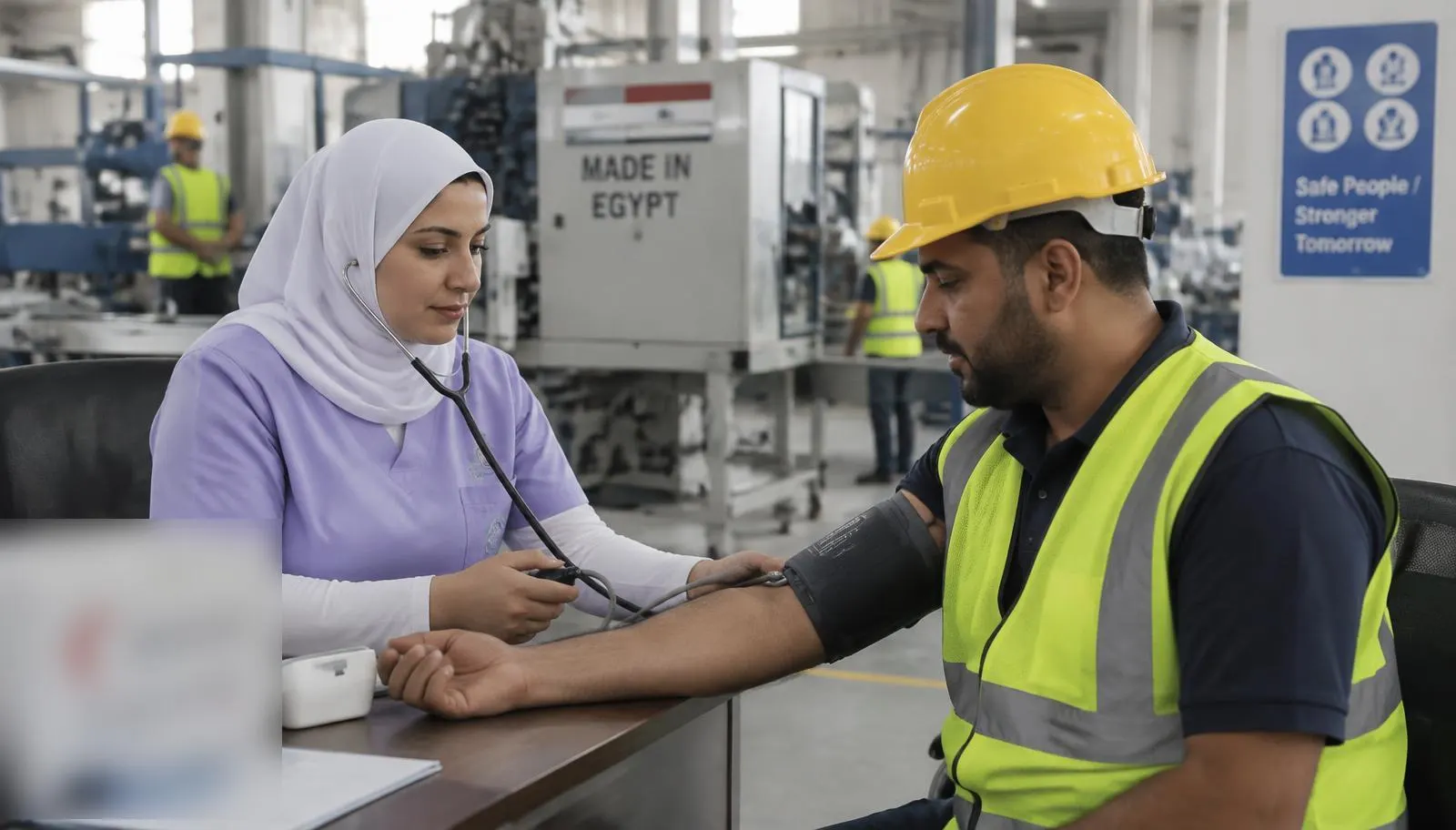
On-Site Spirometry for Factory Workers in Egypt: A Practical Guide for Employers

Quick answer
A practical guide for Egyptian employers with dust-exposed teams: what workplace spirometry is, who should be tested, how to keep test quality high, and how to act on results without penalising workers.
Short answer: on-site spirometry is a breathing test, done at the workplace by a trained technician, that measures how much air a worker can blow out and how fast. For factory teams exposed to dust, it gives a baseline at hiring and a way to spot decline over time. It works only if the technician is trained, the machine is calibrated and a doctor interprets the results. This guide is educational and does not replace medical advice.
- OSHA calls spirometry the most common pulmonary function test; it is used for medical surveillance and for screening workers for certain tasks, and results can inform job assignments, respirator decisions and the assessment of exposure-related effects.
- The WHO lists occupational exposure to dusts, fumes or chemicals as a risk factor for chronic obstructive pulmonary disease (COPD), and says diagnosis is confirmed by spirometry, which is often unavailable in low- and middle-income countries.
- Quality decides value. OSHA recommends technicians complete a NIOSH-approved course, a valid test needs at least three acceptable, repeatable efforts, and the spirometer must be calibration-checked daily.
- Egypt: a 2016 study of 150 workers at the Misr Beni-Suef cement factory found cough in 37.3%, phlegm in 35.3% and breathlessness in 32.7%; the authors recommended pre-placement and periodic medical examination for all workers.
- A result is information for care and prevention, not a reason to dismiss a worker. Plan referral, exposure review and confidentiality before testing starts.
What workplace spirometry measures
OSHA's guidance on spirometry in occupational health programmes describes the test as the most common pulmonary function test. The worker breathes in fully and blows out as hard and as long as possible into a sensor. The key readings are forced vital capacity (FVC), the total air blown out; forced expiratory volume in one second (FEV1), the amount blown out in the first second; and the FEV1/FVC ratio. Results are compared with reference values based on sex, age and height, and, more usefully in a workplace, with the same worker's earlier results. OSHA notes that spirometry tracks an individual's respiratory status over time and can also serve as a group surveillance tool. It does not diagnose a disease on its own; abnormal results may warrant further clinical evaluation.
Who should be tested
Employers should not test everyone by default. Start with a hazard assessment: which tasks create dust, fumes or vapours, how long are workers exposed, and what controls and respirators are used? Cement, stone and marble cutting, ceramics, foundry work, flour milling, textile and woodworking are typical Egyptian settings where inhaled dust is a concern. In the US, OSHA's silica standard for construction requires spirometry as part of medical surveillance for workers who must wear a respirator for 30 or more days a year, at the initial examination and every three years. That is a United States rule and it is cited here only as a reference point for frequency, not as an Egyptian requirement. For your own site, the occupational physician decides who is tested and how often, based on the exposure assessment.
What the Egyptian evidence shows
Egyptian data on workplace spirometry are scattered. One useful descriptive study by nursing researchers from Cairo and Beni-Suef universities, published in the Egyptian Journal of Health Care in 2016, interviewed 150 workers at the Misr Beni-Suef cement factory, chosen by convenience sampling. It reported cough in 37.3%, phlegm in 35.3%, breathlessness in 32.7%, wheeze in 30.7%, chest tightness in 28.7% and chronic bronchitis in 22.0%. Risk factors identified were advancing age, longer exposure, smoking, education level, poor use of protective equipment and poor ventilation. The authors recommended pre-placement and periodic medical examination for all workers and health education on respiratory disease prevention. The study relied on questionnaires and a checklist; it did not report spirometry results, and it was a single factory, so it should not be read as a national estimate. Its value for employers is the pattern: symptoms were common, and protective equipment use and ventilation were part of the picture.
How to run on-site spirometry properly
A badly performed test is worse than none, because it produces numbers that look reliable. OSHA's guidance sets out what quality looks like.
- Trained technician: OSHA recommends that technicians complete an initial NIOSH-approved spirometry course, usually two to three days with hands-on practice, and keep their certification current. Limit testing to a small number of trained people.
- Calibration: check the spirometer daily before testing, again at least every four hours on heavy testing days, and after any equipment change or relocation. A 3-litre syringe should read between 2.90 and 3.10 litres. If a check fails, do not test workers until the problem is fixed.
- Valid effort: a valid test needs at least three acceptable and repeatable manoeuvres, with up to eight attempts; the two largest FVC values, and the two largest FEV1 values, should be within 0.15 litres of each other, and no exhalation should last longer than 15 seconds.
- Readiness: postpone testing for a worker who has smoked, used a bronchodilator or eaten a heavy meal in the past hour, who has a respiratory infection, or who is recovering from recent illness or surgery; OSHA lists the waiting periods.
- Interpretation: a physician or trained healthcare professional should confirm the test is technically valid before reading the numbers. OSHA quotes ATS/ERS that relying only on numerical results without a quality review is a common mistake.
What results mean for HR
Results go to the worker and the occupational physician. HR should receive only what it needs, such as fit for the task, fit with conditions or needs review, never the raw numbers. OSHA notes that results can inform job assignments and respirator decisions, and that the physician should review grouped data to detect patterns that point to a hazardous exposure. That second use is where the employer benefits most: if several workers in one area show decline, the first question is the dust control, not the workers. Article 135 of Labour Law 14 of 2025 requires employers to keep results of employer-requested drug and infectious-disease tests confidential; apply the same discipline to lung-function results, and see our guide on employee health data confidentiality. Do not use an abnormal result alone to dismiss a worker; agree referral, exposure review and any task adjustment with the physician first.
An illustrative scenario in the 10th of Ramadan City
This example is illustrative, not a real case. A ceramics factory with 120 workers in the 10th of Ramadan City asks its occupational physician to review dust risk. The physician classifies the glaze-mixing and cutting teams, 35 people, as dust-exposed and recommends a baseline spirometry for them. The company arranges a testing day on site with a trained technician. The spirometer is calibrated at the start of the day and again after four hours; workers who smoked in the past hour wait. The physician reviews every curve for quality, then sends each worker a private report and a short explanation. Four workers are referred for clinical evaluation, and the grouped data prompt a review of extraction fans at one cutting station. HR receives a list showing each worker as fit, fit with conditions or review pending. The point: baseline first, quality control, grouped data used to improve the workplace.
Checklist before you start
- Complete a written exposure assessment by task and area.
- Confirm that the provider's technician holds a NIOSH-approved (or equivalent) spirometry certificate and ask to see the calibration log.
- Name the physician who interprets results and handles referrals.
- Agree who receives which information and how reports are stored.
- Plan follow-up: repeat testing interval, referral route, exposure controls and respirator checks.
- Pair with hearing conservation if noise is also present; see our guide on on-site audiometry.
How Hospitalia can help
Hospitalia is an Egypt-based integrated home healthcare and corporate medical services platform. Its corporate service pages describe occupational health services and on-site diagnostics. Whether on-site respiratory testing can be arranged for your site, with what equipment, staffing and availability, is confirmed during assessment; we do not assume it. Our guide on occupational health services for factories and our guide on setting up an on-site clinic explain related decisions.
Call 01063151838 or send an enquiry and we will confirm what can be arranged for your workplace.
Ask about on-site diagnosticsFrequently asked questions
What is on-site spirometry?
It is a breathing test done at the workplace by a trained technician. The worker blows out as hard and as long as possible into a sensor, which measures forced vital capacity, FEV1 and their ratio. A doctor interprets the results, and abnormal results may need further clinical evaluation.
Which factory workers should have lung-function testing?
Start with a hazard assessment by task and area. Workers exposed to dust, fumes or vapours, such as in cement, stone, ceramics, flour milling or foundry work, are typical candidates. The occupational physician decides who is tested and how often.
How often should spirometry be repeated?
It depends on exposure and the physician's judgement. As a reference only, OSHA's US silica standard for construction requires spirometry at the initial examination and every three years for covered workers. That is not an Egyptian requirement.
Can a worker be dismissed for an abnormal spirometry result?
An abnormal result alone is not a diagnosis; it may call for clinical evaluation. Agree referral, exposure review and any task adjustment with the physician first, and take legal advice before any employment decision.
Who should see the results?
The worker and the occupational physician. HR should receive only what it needs, such as fit, fit with conditions or review pending. Apply the confidentiality discipline of Article 135 of Labour Law 14 of 2025.
Can Hospitalia run spirometry at my factory?
Whether on-site respiratory testing can be arranged, with what equipment and staffing, is confirmed during assessment. Call 01063151838 to ask.