Heat Stress at Work in Egypt: An On-Site Care Plan for Outdoor and Factory Teams

Quick answer
Heat reduces productivity and can cause serious illness. A practical on-site care plan for Egyptian employers with outdoor, factory and logistics teams, based on WHO, WMO and NIOSH guidance.
Short answer: protecting workers from heat needs a written plan, not only water coolers. The plan should cover gradual acclimatisation, cool drinking water close to the work area, rest breaks that lengthen as conditions worsen, trained staff who can recognise heat illness, and a clear route to medical care. In August 2025 the World Health Organization (WHO) and the World Meteorological Organization (WMO) issued new guidance on workplace heat stress, noting that worker productivity drops by 2 to 3% for every degree above 20°C. This guide turns that guidance and US NIOSH recommendations into an on-site care plan for Egyptian employers. It is educational and does not replace medical advice or the requirements of the competent Egyptian authorities.
- WHO and WMO (22 August 2025): worker productivity drops by 2 to 3% for every degree above 20°C; they cite ILO reports that more than 2.4 billion workers are exposed to excessive heat worldwide, linked to more than 22.85 million occupational injuries each year.
- WHO and WMO recommend occupational heat-health policies tailored to local weather, specific jobs and worker vulnerabilities, with particular attention to middle-aged and older workers, people with chronic conditions and those with lower physical fitness.
- They also recommend training employers, workers and health professionals to recognise and treat heat stress, because its symptoms are often misdiagnosed.
- NIOSH recommends building up time in the heat gradually over 7 to 14 days, with water below 15°C close to the work area, and rest breaks whenever a worker feels heat discomfort.
- Heat stroke is an emergency: it can be fatal if treatment is delayed. In Egypt, call 123 for an ambulance.
- These are international guidelines, not Egyptian regulations or Egyptian statistics. We have not verified a national Egyptian figure for heat illness at work, so we do not quote one.
Why heat is an employer issue
Heat affects output, safety and health at the same time. The WHO and WMO guidance states that productivity falls by 2 to 3% for every degree above 20°C, and that the ILO links excessive heat exposure to millions of occupational injuries every year. Egypt has long hot seasons and many roles with heat exposure: construction and infrastructure, agriculture, ports and logistics, factories with hot processes, kitchens, and drivers. Indoor work is not automatically safe: poorly ventilated warehouses and production halls can be as demanding as outdoor sites.
Who is at higher risk
WHO and WMO ask employers to pay special attention to middle-aged and older workers, people with chronic conditions and those with lower physical fitness. Workers who are new to a site, or returning after a break, also need extra care because they are not yet used to the heat. Workers who wear protective clothing or do heavy tasks are exposed to more strain. Employees with conditions such as diabetes should have access to medical advice about working in hot conditions; our guide on diabetes screening for employees explains how to offer confidential support.
A five-part on-site heat care plan
1. Acclimatise new and returning workers
NIOSH recommends increasing time in hot conditions gradually over 7 to 14 days. For new workers, it suggests no more than 20% of the usual heat-work duration on the first day, then no more than a 20% increase each additional day. For workers with prior experience it suggests no more than 50% on day one, 60% on day two, 80% on day three and 100% on day four. New employees should be closely supervised for the first 14 days or until fully acclimatised, and workers who are not physically fit need more time.
2. Provide water and rest
NIOSH recommends cool water, below 15°C, accessible near the work area. For moderate heat activity lasting under two hours it suggests drinking one cup (about 240 ml) every 15 to 20 minutes, and sports drinks with balanced electrolytes when sweating continues for several hours. It advises avoiding alcohol and drinks high in caffeine or sugar, and says fluid intake should generally not exceed 6 cups per hour. Allow rest and water breaks whenever a worker feels heat discomfort, and shorten work periods and lengthen rest periods as temperature, humidity or sunshine increase, when there is no air movement, when protective clothing is worn or for heavier work.
3. Plan the work
These are practical measures consistent with the guidance above; they are our suggestions rather than quotations from it. Schedule the heaviest tasks for cooler parts of the day, provide shade or cooled rest areas, rotate tasks, improve ventilation in indoor spaces and use the buddy system so that workers watch one another for signs of illness. Involve workers in designing the plan, as WHO and WMO recommend.
4. Train people to recognise heat illness
WHO and WMO note that heat stress symptoms are often misdiagnosed, so supervisors and first-aid staff need training. NIOSH describes the warning signs below. Training should also cover how to give first aid and how to contact emergency services.
| Condition | Signs | First aid |
|---|---|---|
| Heat cramps | Muscle cramps; pain or spasms in the abdomen, arms or legs | Drink water and a snack or drink that replaces carbohydrates and electrolytes every 15 to 20 minutes; avoid salt tablets; seek medical help if the worker has heart problems, is on a low-sodium diet or cramps do not subside within 1 hour |
| Heat exhaustion | Headache, nausea, dizziness, weakness, irritability, thirst; heavy sweating; elevated body temperature; decreased urine output | Take the worker to a clinic or emergency room for evaluation; move them out of the hot area, give liquids, remove unnecessary clothing and cool with cold compresses or cold water on the head, face and neck; stay with them until help arrives |
| Heat stroke | Confusion, altered mental status or slurred speech; loss of consciousness; hot dry skin or profuse sweating; seizures; very high body temperature | Emergency: call 123, stay with the worker, move them to a shaded cool area, remove outer clothing, cool them quickly (cold water, wet skin, wet cloths, air circulation) and place cold wet cloths or ice on head, neck, armpits and groin |
NIOSH describes heat stroke as fatal if treatment is delayed. The first-aid steps above summarise NIOSH guidance; your first-aid trainer and the treating clinician decide the exact procedure. NIOSH refers to the US emergency number; in Egypt use 123.
5. Set up a route to medical care
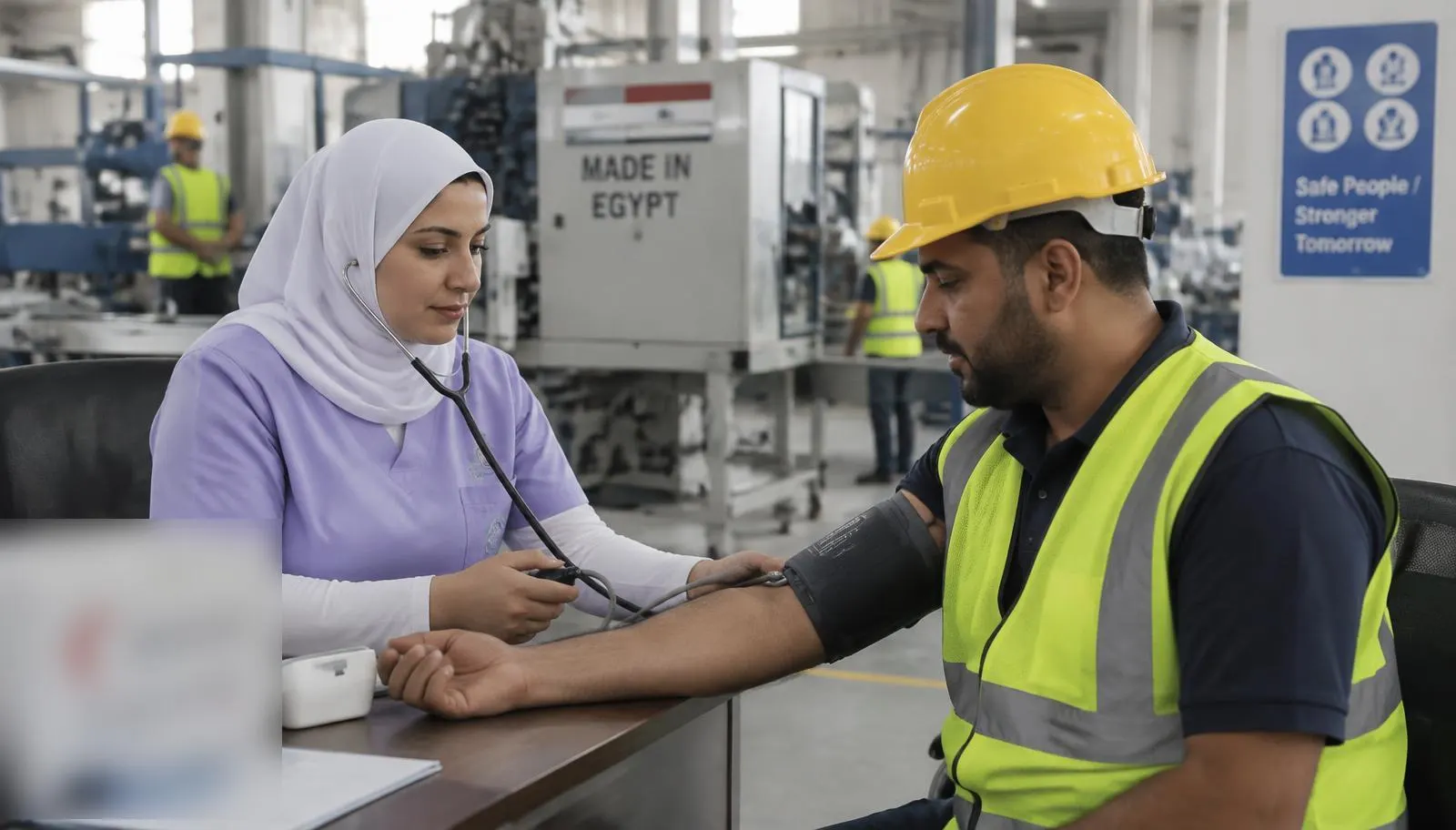
Decide in advance who assesses an unwell worker, where they go, who calls the ambulance and how the site address is given to the dispatcher. Sites with an on-site clinic, nurse or visiting doctor can assess workers quickly and decide on referral. Smaller or remote sites can agree a nearby facility and a telemedicine option. Link the heat plan to your workplace first-aid and emergency plan.
What on-site care can look like
Options range from trained first-aiders with a heat-illness checklist, to scheduled nurse or doctor visits in the hot season, to a full on-site clinic. Typical components are pre-season briefings, health questions for new starters, rapid assessment of workers who feel unwell, cooling and rehydration support, referral to hospital when needed and aggregated reporting to management. The right model depends on headcount, site conditions, shift patterns and budget; our guide on setting up an on-site clinic explains the planning questions. On-site care supports, but does not replace, emergency services.
Measuring whether the plan works
Track a few indicators you can collect without exposing individuals: heat-related first-aid cases and referrals by site and month, time from first symptom to first assessment, the share of new workers who completed an acclimatisation schedule, and the share of supervisors trained. Review after each hot season and report only aggregated figures.
Check your legal obligations
Occupational safety and health requirements, including limits on hot work, are set by Egyptian law and the competent authorities. We have not verified specific heat limits for this article, so confirm current requirements for your sector and sites with your legal and safety advisers.
How Hospitalia can help
Hospitalia is an Egypt-based integrated home healthcare and corporate medical services platform. For employers it offers on-site employee health programmes, doctor consultations and telemedicine. Whether a heat-season programme, visiting nurses or first-aid training can be arranged for your sites, and on what terms, is confirmed with each client after a site assessment.
Call 01063151838 or request a corporate proposal and we will scope an on-site care and first-response plan for your sites and shifts.
Request a corporate proposalFrequently asked questions
What is heat stress at work?
Heat stress is the strain on the body from working in hot conditions. It can cause cramps, heat exhaustion and heat stroke. WHO and WMO note that its symptoms are often misdiagnosed, so supervisors and first-aid staff need training.
How does heat affect productivity?
WHO and WMO state that worker productivity drops by 2 to 3% for every degree above 20°C.
How long does it take workers to get used to the heat?
NIOSH recommends building up time in hot conditions gradually over 7 to 14 days, with closer supervision for new employees during their first 14 days. People who are not physically fit need longer.
How much water should workers drink in hot conditions?
NIOSH suggests one cup (about 240 ml) of cool water every 15 to 20 minutes for moderate heat activity lasting under two hours, and sports drinks with balanced electrolytes for several hours of sweating. Fluid intake should generally not exceed 6 cups per hour. People with medical conditions should follow their doctor's advice.
What should I do if a worker may have heat stroke?
Treat it as an emergency: call 123, stay with the worker, move them to a cool shaded area, remove outer clothing and cool them quickly with cold water or wet cloths while waiting for the ambulance. Signs include confusion, slurred speech, seizures or loss of consciousness.
Can an employer arrange on-site medical support for hot-season work in Egypt?
Yes. Employers can arrange first-aid training, visiting nurses or doctors, or an on-site clinic through a medical services provider. The scope and legal requirements for your facility should be agreed with the provider and confirmed with the competent authorities.